Saturday, October 25, 2014

( Kumiko's post) Christian Mcbride on I-90!!

A small road trip to Roslyn, WA with my co-Jazz critic Kenneth E Lawrence. We agreed on five stars on Christian Mcbride's albums on cloudy-misty I-90 in fall. We had lunch at the famous Roslyn Cafe.


Saturday, August 30, 2014

Gamelan (Javanese/ Balinese)

Playing gamelan washes the brain. It’s an amazing experience. It is famously difficult to make decent recordings of gamelan, but even the best recording doesn’t compare to sitting surrounded by sounds. In Javanese gamelan, there are patterns within patterns. Density increases when the structure is slowed, so the slower you play, the faster the music gets. You can hear these things on recordings, but the shimmering effect is lost.
Balinese gamelan is very different from Javanese. While Javanese love subdividing and gradual changes in speed and dynamics, the Balinese love complex interlocking rhythms and contrast. Changes from loud to soft are immediate in Balinese gamelan. I used to spend Saturday afternoons playing Javanese gamelan and Wednesday evenings playing Balinese gamelan. I wonder how my brainwave patterns differed during practice sessions.


Tuesday, August 19, 2014

Golden Heron Gamelan at Village Green Perennial Nursery

Always a pleasure to perform gamelan with our group Golden Heron. These photos were taken during our performance at Village Green Perennial Nursery, a beautiful setting, perfect for gamelan. With director Jeff Milano,


Friday, July 25, 2014

( Kumiko's post) Lunch inspired by our Mahabharata-themed book project!

Our new Mahabharata-themed book project is taking shape. We were inspired to have a picnic with Indian takeout food this afternoon. There are a couple of good Indian restraurants and Indian grocery stores in Bellevue- Redmond area:) — with Kenneth E Lawrence


Wednesday, April 30, 2014

Mahabharata at the Chapel


Thanks everybody who came to see Soju Projekt’s ‘Shikhandi/Amba,’ my Mahabharata-based piece for small ensemble. It’s always interesting to throw together solid musicians from diverse backgrounds (renaissance vocalists, western flute, Japanese taiko and gamelan) and see how they come together. Their feedback on my libretto and score was invaluable. And what a gorgeous place to play!

Monday, April 28, 2014

Biwa and Sumie at Microsoft Headquarters

In 2014, Soju Projekt presented a lecture-performance with Chikuzen-style Biwa master Kyokumi Tashiro at Microsoft Headquarters in Redmond, Washington. Kenneth E. Lawrence's pre-performance lecture provided background on the samurai warrior Yoshitsune in legend and history, and on the biwa (Japanese lute). The performance proper featured Kyokumi Tashiro performing the piece 'Funa Benkei' (Benkei on the Boat). The text of the piece, translated by members of Soju Projekt, was projected with paintings of scenes from the story by sumi-painter Kumiko Lawrence.

The story of 'Funa Benkei' is taken from 'Gikeiki,' an anonymous collection of legends that embroidered the life of the 12th century historical figure Yoshitsune. Similar in form to the Noh play of the same name, the story is split evenly between the melancholy and the dramatic. The first section relates the sad parting of Yoshitsune, fleeing by boat with several of his followers, and his lover Shizuka. 

Shizuka, with no heart to dance, merely waves her sleeves in sorrow.  

‘Misfortune brings great pain,” she sings, “but trust in me.” A happy song, though the sea is carrying her love away. May wind and wave speed him on! 

Last year he bravely rode forth, leading an army westward, destroying the Taira and drowning them in the sea. Now all knew his name: Yoshitsune! But a despicable villain’s slander made him a hunted man, a tragic misunderstanding. With only the rising moon to guide him, he hastily abandoned the capital, fleeing with a dozen trusted companions towards the western provinces. Their lives, like all lives, are the sport of fate. They fled in boats downriver, adrift like clouds on the water, finally arriving at the ocean shore. 

“Take your places aboard. Let’s get this vessel underway!”  

Shizuka is speechless with weeping, but what must be shall be. Let all the world whisper as it will. In tears she removes hat and cloak, drops them at her feet and bids Yoshitsune farewell. 

But the story immediately shifts from sadness to the supernatural.

“Pull away! Put your backs into it!”  

It is a good, stout ship and the day is perfect, surely a sign of coming good fortune. 

But a cloud hangs over Mount Muko where there was no cloud before. It comes their way. 

An outstanding crew, but this is no ordinary storm. “Look lively!” High winds; the waves rise. They are in the teeth of a tremendous gale. The ship has no hope of ever reaching land.  

Eerie! Spirits gather like clouds, rising, riding the uproarious sea. Wave-borne upon the ocean, the whole host of the Taira, who, not long since, drowned in the west, all of them! For them, the moment is perfect to vent upon all their pent-up rage. All hearts quake with terror as they stare, wide-eyed. “The Taira nobles drowned in the battle of Dan-no-ura now swarm before our eyes,” one man cries, “evil spirits resolved to destroy us!”  

“Hold your tongue,” shouts the captain.  

Before them, with a sword at his waist and gripping a halberd, they see the phantom of Tomomori, chief commander of the Heike. He glares at the ship. “Today, I will drown Yoshitsune in the sea!” With a scream he grips his halberd for battle, sweeps it wide. It curls like the waves, kicks high the salt foam, until all sight grows dim. 

Yoshitsune draws his sword and the two close in combat, but Yoshitsune’s skill is skill is useless against such a foe, a foe not of this earth. The warrior-monk Benkei protects his lord Yoshitsune by thrusting himself between the two. Rhythmically rasping together his rosary beads he summons the wrathful guardians of the four directions, in their center Fudo the Unmoving, whose noose binds evil powers. Together the protector divinities form a mandala. Fiercely Benkei prays until Tomomori’s sinister spirit staggers back. Benkei lends his strength to the straining crew as they row the ship on toward the distant shore. The evil spirit, pursues them still, but prayer and sword and the ebbing tide bear him, tossing and rocking, far across the waves: he disappears. 

Kyokumi Tashiro began her training in Chikuzen Biwa in 1993 with her grandmother, Kyokuei Kubo.  Her grandmother was one of only a few masters trained by the original Chikuzen Biwa Master Kyokushu Tachibana (1892-1967). Under her grandmother’s training, Kyokumi received her master certification in 2000. She received her master certification from the Chikuzen Biwa Nihon Tachibana Association and is a member of the Japan Biwa Music Society. She has an amazing voice. Soju Projekt looks forward to working with her more in the future.

Thursday, February 20, 2014

Ken's "The City of Brass' in Spring 2014 issue of Parabola Magazine.

My retelling of 'The City of Brass' was featured in the Spring 2014 issue of Parabola Magazine. When I first heard about the theme of the issue, wisdom, many stories from epics and great books, both East and West, came to mind. A tale from the Bible or the Mahabharata? Something from Rumi's Masnavi or the Shahnameh of Ferdowsi? Irish, Mandinka, Chinese... So many world traditions to choose from! I was a bit overwhelmed at first, but finally a personal quirk won out: I have a love of twists. I chose to retell 'The City of Brass' not so much to be shocking as to be unpredictable. 

What intrigued me about 'The City of Brass' is the presentation of wisdom, or the attainment of it, as a bad thing. Few people, even the most virulent anti-intellectuals among us, disdain wisdom. But in the frame story as I present it, Scheherazade, though a captive to and a victim of her husband's mental illness - she has lived in terror for five hundred and sixty-five nights - is able to use her only protection, her stories, as a weapon. She yearns for freedom, which she perceives as blue, the color of sky. In her anger and resentment, she plots a kind of revenge, the revealing of a wisdom "pure and unbearable."

The form of the Thousand Nights and a Night, stories-within-stories (within-stories-within-stories...), has long been intriguing to me. It changed my way of reading, may way of writing, even my way of experiencing life. Compressing the stories-within-stories in 'The City of Brass' into a short-story length suitable for a magazine exacerbated its dreamlike qualities, I think, to great effect (at one point Scheherazade tells the story of Musa telling the story of an ifrit of the jinn telling the story of his war against Solomon). 

In Scheherazade's story, Musa, the protagonist, returns from his journeys with riches and marvelous gifts. He has witnessed wonders, but rather than enjoy the fruits of his labor and be celebrated at a feast, he wants nothing of fame or worldly possessions. He is tired, disillusioned and cynical. He has attained wisdom: Even the greatest kings are now food for worms, their empires crumbled to dust. 

There is a spider crouching on the shoulder of each of us, waiting for its moment, and that spider is death. Death is the clearest truth. That is the wisdom that Scheherazade shares with her husband.

Thursday, July 4, 2013

Noh in Seattle


Because of my work at the National Noh Theatre and the International Theatre Institute, and as a columnist for the Japan Times specializing in traditional Japanese music and theater, I’ve seen hundreds of Noh performances over the years by many top performers, but I was still knocked out last weekend by the power of Munenori Takeda and Fumiyuki Takeda, two Noh artists visiting from Japan, when I heard them chanting on Bainbridge Island. Truly excellent! They flew out yesterday and already I’m going through withdrawals!
 
 Photo courtesy of   SUGOI EXPERIENCE JAPAN
 

Saturday, June 29, 2013

Saluang Flute

The saluang is a bamboo flute of the Minangkabau people of Western Sumatra, Indonesia. I studied it in preparation for a performance of Randai, a martial-arts based dance-drama. It has a airy sound, dry and meditative, and requires circular breathing (breathing in through the nose while blowing out through the mouth with no break in sound). Through it I lose time.
 
Photo by Kumiko Lawrence
 

Sunday, May 26, 2013

Himalayan Singing Bowl certified


There is a shimmering, like leaves on a tree when it sways in the breeze. Our minds perceive and simplify. We’ve seen it before, many times. It is a tree. They are leaves. The wind is blowing. But we do not, perhaps cannot, perceive the whole: The tree, that particular tree, is not the same as it was yesterday. Our experiences in the last twenty-four hours have changed our way of perceiving. We feel we’re standing in the exact same spot, but that spot, our posture, the slight change of light has altered our perception. The tree, the leaves, the self, change imperceptibly with each moment.

It is the same with sound.
I am now a certified practitioner of Himalayan singing bowl healing. My instructor, Suren Shrestha, showed me an effective treatment to release stress and muscle tension or to cure insomnia and migraine headaches. Gently strike an inverted large bowl while it rests on your head. In the west we would call the sound produced a ‘drone’, a sustained sound or repeated note, but the actual sound is extremely complex, like sunlight reflected off a lake, an infinity of shifting angles. The mind struggles to analyze the patterns, is overwhelmed, shuts down. The mind’s surrender is relaxation. 
Suren Shrestha : http://surenshrestha.com/

Sunday, May 5, 2013

Mahabharata (The magazine Parabola)


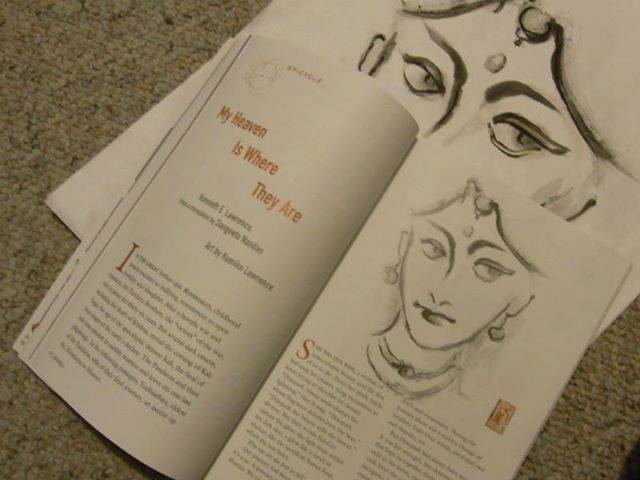
Kumiko Lawrence’s sumi-paintings are featured in the summer 2013 issue of the magazine Parabola together with a Mahabharata-based short story by Kenneth E Lawrence . Thank you all for making this possible.

  Sumi Kumi Works.com

Wednesday, March 27, 2013

Soju Kai Recap by Heather Porter

Our friend Heather Porter posted a recap of Soju Kai’s March 24 lecture/performance ‘Healing in Noh’ on her blog ‘Hanamichi’. An excellent recap with great photography by Heather Jackson.


Tuesday, March 26, 2013

Healing in Noh @ Nagomi Tea House


On March 24 Soju Kai presented a lecture/demonstration at the Nagomi Teahouse in Seattle’s International District. I recently began writing a monthly column for the Hokubei Houchi (North American Post) newspaper entitled ‘Tales from the Noh’. During our first meeting there, we were pleasantly surprised to discover the Nagomi Teahouse downstairs, a beautiful and intimate space.


We chose as our theme for the presentation ‘Healing in Noh’, and focused on specifically on healing through sympathy as expressed in the Noh play ‘Atsumori’. Kumiko opened the performance with a celebratory chant from the play ‘Tsurukame’. I then spoke on the music, movement and chant of Noh, as well as its history and esthetics. Kumiko demonstrated jo-ha-kyu, then danced a section of the play ‘Yuya’.


The presentation also featured backstage photos of Kumiko’s father Yoshio Negishi, a licensed Noh performer. Masks carved by Kumiko’s mother, Yukie Negishi, a Noh performer and accomplished Noh mask carver, were modeled by stage performer/dancer Yuuki Hoashi.


The performance continued with a staged reading of my retelling of the play ‘Atsumori’, as published in the Summer 2012 issue of the journal Parabola. Kumiko’s sumi paintings of scenes from the play were also featured.


The performance ended with a video clip from a live performance of ‘Atsumori’, danced by Hideo Fukuhara, Kumiko’s uncle.

Photography courtesy of Heather Jackson.